
For Students: A Civic Education and Innovation Guide
Real Experience, Real Impact
The CLS’s Civic Education and Innovation office doesn’t offer a simple checklist or prescribe a single pathway for learning how you might want to participate in civic life. Instead, at Grinnell you will find an ecosystem of opportunities both within and beyond the classroom where you may:
- Deepen your understanding of yourself and the world around you,
- Build relationships across communities and perspectives, and
- Explore how might apply your knowledge, values, and skills to help co-create the world you want to live in.
How to Get Involved
There are multiple entry points to civic life at Grinnell. Some students arrive with prior community engagement experience or a strong interest in a particular civic area. Others are exploring where their interests lie and what engagement might look like. At Grinnell you can begin in many ways:
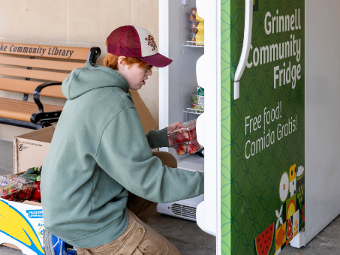
- Some students begin with service by volunteering directly in the local Grinnell community,
- Others start in a classroom or with a co-curricular mapping project researching the intricacies of oppressive systems,
- And still others are begin with grass roots issue advocacy and join a campus/community dialogue.
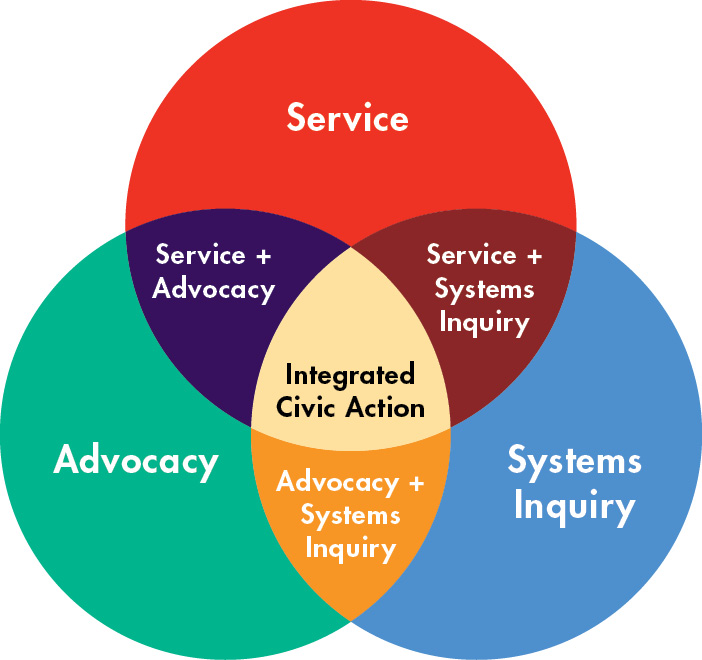
All of these are valid places to begin. Over your time at Grinnell, your interests, knowledge, and skills will grow, and you’ll connect with others who care about many of the same issues you do. When people working in different ways join forces—some meeting immediate needs, some asking why those needs exist, and others working to change policies and practices—their efforts can come together to create lasting change.
Flexible, Inter-Connected Learning Opportunities
At Grinnell, you are invited to explore how different forms of civic and community engagement connect with and inform one another over time.

Service: Volunteering in the Community
Many students begin their civic journeys through direct, relationship-centered engagement with people and organizations in the Grinnell community. Students begin to act as civic neighbors while learning about Grinnell’s particular local context. They learn how community members define their own needs and priorities as well as why building relationships of trust, collaboration, and humility are central to civic work.
Examples Include:
- Grinnell supported volunteer initiatives such as the Community Meal, Adult Language Learning Program, After School Art Club, tutoring in the schools, PALS animal shelter support, Girls Who Code, etc.
- Service Leadership Work-Study — paid collaborations with local nonprofits and civic organizations
- Volunteer opportunities found through our Community Partner Database.
Systems Inquiry: Understanding Complexity with a Purpose
You’ll develop a systems-aware approach to civic learning that strengthens critical thinking and problem-solving skills. You’ll learn to move beyond quick fixes by analyzing relationships, examining root causes, and understanding the conditions that shape change across contexts and over time.
This work reinforces core teaching and learning goals by helping students translate complexity into insight and informed, collaborative action. Learning modes include coursework, research, or curiosity about how systems develop, function, and evolve.
Examples Include:
- Map the System or other systems inquiry research projects that identify structures, gaps, and leverage points related to issues students care about, and explore why persistent challenges endure, such as barriers to sensitive end-of-life care for LGBTQIA+ adults
- Non-profit board leadership roles that offer a broader view of organizational systems while building both professional and civic skills
- Community engaged learning (CEL) courses that examine historical and contemporary contexts of policy, power, and institutions within a specific region or issue area


Advocacy: Dialogue, Engagement, and Collaborative Leadership
Through these experiences students practice the relational and leadership skills necessary for civic life. They learn how dialouge can surface new understanding, how advocacy can help translate insight into collective action, and how leadership often involves convening people, building trust, and sustaining collaboration across differences.
These experiences will help you see yourself not only as participants in civic life, but also as facilitators of shared problem-solving and community leadership.
Examples Include:
- Engaging in public scholarship, policy challenges or discussions, forums, and community conversations that connect academic learning to broader social questions and shared concerns
- Participating in community engaged learning classes that examine civic action such as the history of student activism
- Organizing or participating in a Listening Project dialogue session that address a civic issue
Current Signature Programs
CEI’s signature programs offer multiple ways to get involved through service, systems thinking, dialogue, and civic leadership. Wherever you begin, we’ll help you make connections, build relationships, and explore how these different forms of engagement work together to strengthen communities and create change.
- The Listening Project facilitates dialogue across difference, training students and community members as listeners and dialogue facilitators.
- Volunteer Leadership Initiative provides mentored support for students navigating community engagement and growing into civic leadership roles.
- Service Leadership Work-Study Program (SLWS) offers paid, sustained service opportunities with local nonprofit partners.
- Map the System (MTS) engages students in systems thinking to understand and explain complex social and environmental challenges.
- Social Innovator in Residence brings systems change leaders to campus for collaboration, mentoring, and shared learning.
- Community-Engaged Learning (CEL) Courses connect classroom learning with community partnership across disciplines.
- Grinnell Summer of Service is an immersive, cohort-based program combining service, reflection, and systems inquiry.


Additional Resources
- Civic Funding Support — Funding for civic activities
- Civic Transportation Support — Funding and logistics for transportation to and from civic activities
- Community Partner Database — Explore local organizations and community partners
- Grinnell Policy Challenge — Develop policy ideas addressing real-world issues
- Navigate Your Own Civic Journey — Explore different ways to participate in civic life
- Post-Graduate Service Advising — Explore service opportunities after Grinnell
- Social Justice Tour — Explore local history, systems, and your relationship to place
- Systems Inquiry Student Guide — Resources and tools for exploring complex issues and systems
- Visa Considerations — Guidance for international students considering civic opportunities; please consult OISA staff
For More Information:
- Connect with a Civic Education and Innovation Staff Member
- Julie Lascol (Community Engaged Classes)
- Ryan Solomon (Advocacy and Direct Service)
- Vicki Nolton (Systems Inquiry & Social Innovator in Residence)
- Susan Sanning (Associate Dean and Executive Director)
- Contact Grinnell’s Center for Careers, Life, and Service (CLS)
- 641-269-4940
- career@grinnell.edu
- Visit other “Civic Activity” pages on the CLS’s website


